
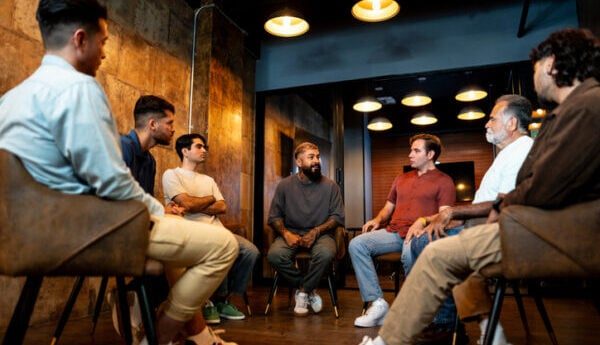

Men’s groups have existed as long as human communities themselves, taking vastly different forms across cultures and eras. Today, as headlines frame men as either “in crisis” or “in decline,” there is far less public awareness of the sheer range of organized men’s groups.
This article maps several major types of contemporary men’s groups, focusing on how each defines male support and its underlying theory of change. This article also offers a few simple guidelines for steering men toward generative spaces of male support.
Rites‑of‑Passage and Initiatory Models
Overview
These groups are an extension of the oldest form of men’s groups, traditional initiation frameworks, drawing from Indigenous cultures where transitions such as boyhood to manhood are marked by ceremony, challenge, and community. The goal is to intentionally “ritualize” male development, rather than leaving it to unstructured socialization.
Theory of change
Men’s identity and behavior are shaped by whether they are ceremonially and communally recognized at key life thresholds. Without such rites, men drift; with them, men are more likely to integrate responsibility, connection, and emotional maturity through the stewardship of elders and peers.
Key beliefs
- Initiation as a threshold between life stages
- Elderhood and mentorship are central to male
- Connection to land and spirit as a source of grounding
- Sacred male development
- Claiming responsibility
- Integrating grief and shame in a communal container
Common practices
- Solo wilderness rites and vision quests.
- Men’s councils and elder‑led circles.
- Ceremonial work, including sweat lodges and other ritual forms.
Influential Figures
-
- This approach is practiced by so many that highlighting individual leaders would not capture its full scope
Religious Men’s Groups
Overview
These groups situate masculine identity within a religious or spiritual text-informed framework, often emphasizing moral discipline, accountability, and spiritual leadership.
Theory of change
Men’s behavior improves when their identity is anchored in a higher moral order and community standards. Sin, failure, and relational conflict are reframed as spiritual issues that can be transformed through devotional practices.
Key beliefs and practices
- Men as spiritual leaders of home and community.
- Male leadership as a moral responsibility.
- Small groups as spaces for confession, accountability, and prayer.
- Male role anchored in a higher moral order and scriptural norms.
- Men are held accountable in small groups for behaviors related to marriage, sexuality, parenting, and honesty.
- Spiritual disciplines reshape men’s sense of purpose and responsibility.
Influential Figures
This approach is practiced by so many that highlighting individual leaders would not capture its full scope.
Therapeutic and Personal‑Growth Men’s Groups
Overview
These groups center on peer support, mental health, and interpersonal skill‑building. They are grounded in the idea that early childhood experiences, attachment patterns, and unresolved trauma shape adult male identity and behavior.
Theory of change
Men’s emotional and relational health improves when they are in safe, structured groups that allow vulnerability. Community based support can help men resolve identity conflicts, reduce symptoms of depression and anxiety, and reconstruct masculinity in health promoting ways.
Key beliefs and practices
- Inner child healing and family‑of‑origin work as central to male growth.
- Attachment theory and generational trauma as explanatory lenses.
- Groups as low threshold access points to treatment, especially for men who avoid individual therapy.
Influential figures
- Terry Real
- Dr. Fredric Rabinowitz
- Dr. Obari Cartman
- Gabor Maté
- Kenny Mammarella-D’Cruz
Common practices
- Men’s group therapy and individual counseling
- Somatic experiencing and nervous‑system regulation
- Peer support groups
Archetypal Men’s Groups
Overview
Dominated by groups that drew from Carl Jung’s work, this approach views personal development as a journey toward individuation. It emphasizes myth, dreams, symbols, and archetypes.
Theory of change
Men’s inner lives are better understood through archetypal and mythic frames. When men reconnect with deeper, symbolic dimensions of masculinity, often described as a “lost deep masculine identity,” they gain perspective on modern role pressures and can reclaim a more authentic self.
Key beliefs and practices
- Shadow work: integrating repressed or disowned parts of the self.
- Archetypal roles of masculinity (e.g., King, Warrior, Magician, Lover) as tools for self assessment.
- Personal myth and soul work as antidotes to superficial performance of manhood.
- The Hero’s Journey (Joseph Campbell) as a narrative structure for male development.
Influential figures
- Robert Bly
- James Hillman
- Michael Meade
- Robert Moore and Douglas Gillette
Common practices
- Storytelling and poetry.
- Rituals and initiations.
- Wilderness retreats.
- Dream work and active imagination.
Embodiment and Somatic Men’s Groups
Overview
These groups put the body at the center of transformation, emphasizing movement, breath and posture. These serve as pathways to healing trauma, allowing for the cultivation of authentic masculinity.
Theory of change
Men’s emotional and relational patterns are held in the body; changing posture, movement, and breath can rewire nervous‑system responses and thus reshape how men relate to themselves and others. Embodied awareness becomes the foundation for the true self.
Somatic men’s work typically assumes:
- Trauma and socialization live in the body; intellectual insight alone is insufficient.
- If men build capacity to stay embodied under stress, they can show up better in relationship
- Nervous‑system regulation and embodied presence are core markers of “mature” masculinity.
Key beliefs and practices
- Nervous‑system regulation as essential to healthy manhood.
- Presence and polarity (e.g., masculine/feminine energy balance) as relational resources.
- Emotional embodiment as an alternative to dissociation or suppression.
Influential figures
- John Wineland
- Shems Heartwell
- Dr. Peter Levine
- Resmaa Menakem
- David Deida
- Richard Strozzi‑Heckler
Common practices
- Breathwork and body‑based meditation.
- Partner and polarity practices.
- Martial arts or conscious movement.
- Emotional release techniques.
Coaching and Performance‑Oriented Men’s Groups
Overview
Often grounded in leadership development, these models draw on life coaching, neuro‑linguistic programming (NLP), and business psychology to help men “level up” emotionally, relationally, and professionally. Coaching‑driven men’s communities frame masculinity as a self‑optimization project.
Theory of change
Men grow when they adopt clear goals. Masculinity is reframed as a project of self‑optimization, with emotional intelligence, leadership, and values alignment serving as levers of success.
Key beliefs and practices
- Personal responsibility and integrity as core values.
- Purpose as a motivator for change
- Groups are performance labs and sites of accountability
Influential figures
- Tony Robbins
- Eric Thomas
- Connor Beaton
- Traver Boehm
Common practices
- Accountability partnerships and group coaching.
- Masterminds and leadership training.
- Goal‑setting and performance tracking.
Spiritual and Transpersonal Men’s Groups
Overview
Spiritual men’s groups frame masculine development as a path of self‑transcendence. They draw on contemplative traditions (Christian, Buddhist, Hindu, Sufi), integral philosophy, or non‑dual teachings.
Theory of change
Men’s identity expands when they move beyond ego and status‑driven concerns to a sense of union with a larger reality. Shadow and light integration, ego dissolution, and spiritual practice are pathways to a more grounded, compassionate masculinity.
Key beliefs and practices
- Masculine presence as consciousness
- Union with the divine is the ultimate goal.
- Ego death and surrender are transformative experiences.
These groups can overlap with mythopoetic, therapeutic, or embodiment spaces, but their primary language is spiritual rather than psychological.
Influential figures
- Ram Dass
- Adam Jackson and Kale Ka’alekahi
- Ken Wilber
- Lama Rod Owens
- Thich Nhat Hahn
Common practices
- Meditation and contemplative prayer.
- Ritual and sacred practice.
- Study of sacred texts and philosophy.
Men’s Rights / Men’s Advocacy Spaces
Overview
Men’s rights and advocacy spaces focus on where men are structurally vulnerable: suicide, homelessness, incarceration, occupational deaths, educational disengagement, and certain aspects of family law.
Theory of change
Societal structures can be changed to better serve men, especially in areas where men are at higher risk (e.g., suicide, incarceration). The moral engine is problem‑solving and reform, not necessarily opposition to women or feminism.
Key Beliefs and Practices
-
- Policy, law, and public‑health systems have under‑recognized male‑specific vulnerabilities.
- Addressing these gaps, through more gender‑inclusive mental‑health strategies, attention to fathers’ rights, and recognition of male victimization, would reduce harm for men, women, and children.
- Advocacy should push institutions to treat men as relationally invested and emotionally capable, rather than potential perpetrators.
Male Grievance Spaces (The “Manosphere”)
Overview
The manosphere ideolizes hegemonic ideas of power and subjugation as alleviation to male grievance and suffering.
Theory of change
Men are framed as culturally dispossessed, often in a zero‑sum view of gender change. Relief is imagined through the restoration of masculine power, often defined in hierarchical and dominance‑based terms. Vulnerability is to be corrected to reclaim power.
Key Beliefs and Practices
Shared ideological features across Men’s Rights Activist (MRA), red‑pill, Men going their own way (MGTOW), and Pick up artists (PUA) spaces:
- A belief that modern social, legal, and cultural systems disadvantage men.
- Heavy reliance on evolutionary psychology, dominance hierarchies, and status competition as explanatory frameworks.
- Hyper‑individualism, expressed as emotional detachment, strategic self‑interest, or institutional distrust.
- Deep criticism of feminism and gender equality, often framed as threats to male status.
- Endorsement, implicit or explicit, of hierarchical, exclusionary, or dehumanizing narratives. Often focused around race, gender, and “weak” men.
Prominent Figures
Andrew Tate
Aiden Ross
Jordan Peterson
Paul Elam
Fresh and Fit podcast
*Nuance and danger
Not every manosphere community is equally extreme, and some participants do report personal growth (e.g., fitness, discipline, earning more). Male grievance is fine until it passes certain thresholds.
The orientation toward dominance, control, and dehumanization makes these spaces particularly concerning. The lack of clear boundaries and the porousness between self‑help and extremist framing make them difficult to track empirically, yet they are a significant cultural force.
Feminist‑Aligned / Pro‑Feminist Men’s Groups
Overview
Feminist‑aligned men’s groups (often called pro‑feminist men’s movements) focus on engaging men in challenging patriarchal norms, ending gender‑based violence, examining male privilege and socialization, and promoting gender equity. They frame masculinity as socially constructed and argue that rigid gender norms harm society as a whole.
Theory of change
Masculinity is inherently hegemonic. Men can unlearn toxic masculinity through unlearning patriarchy and adopting feminist centered understandings of maleness. Through this, men can develop a more grounded and self-directed sense of masculinity:
Key Belief and Practices
- Male dominance is structural but also manifests interpersonally and intrapersonally
- Masculinity is culturally rewarded and linked to power and violence
- Race, class, sexuality, and other identities are shaped patriarchal power
- Facilitated dialogues on privilege, accountability, and repair
- Public awareness campaigns and community organizing
Prominent figures and organizations
- Michael Kimmel
- Jackson Katz
- Bob Pease
- Tony Porter
Fraternal Organizations
Overview
Fraternal organizations are structured, membership-based brotherhoods. These groups often operate with formal hierarchies, initiation rituals, and long-standing institutional structures. Historically, fraternal organizations have played major roles in political leadership.
Theory of Change
Structured brotherhood cultivates character, which in turn strengthens families and communities.
Key Beliefs
- Brotherhood and loyalty
- Ritual initiation
- Symbolism and secrecy
- Moral uprightness
- Charity
- Structured leadership development
Common Practices
- Formal initiation ceremonies
- Regular lodge or chapter meetings
- Philanthropic projects
- Community service initiatives
- Leadership roles and officer structures
- Networking and professional mentorship
- Structured codes of conduct
Helping Men Find Men’s Spaces
Given this landscape, the question is not whether men will seek out communities of men, they already are, but whether we are willing to acknowledge the range of spaces available to them.
Public conversation often collapses men’s groups into the most extreme examples, especially those associated with the online “manosphere.” But that narrow focus obscures the sheer diversity of men’s gatherings taking place.
For clinicians, educators, partners, and community leaders, the task is not to decide which space every man should join, but to become literate in what exists. A few orienting questions can help:
- What kinds of men’s spaces exist in my local community?
- When a man expresses a need for a community of men, do I have somewhere concrete to suggest?
- If I cannot find this space in my community, how can I identify men who are already doing this work? How can I invite them in?
Not every space will resonate with every person. A group that feels uncomfortable to one observer may be deeply meaningful for the men who gather there.
Men need pathways to groups that align with their values, needs, and stage of life. If we stop acting as though men’s groups are rare or inherently suspect, we make it easier to support the men in our lives in finding communities that strengthen them.
==
Disclaimer: This story is auto-aggregated by a computer program and has not been created or edited by healthlydays.
Publisher: Source link