The Joys and Challenges of Becoming an Effective and Loving Male Caregiver
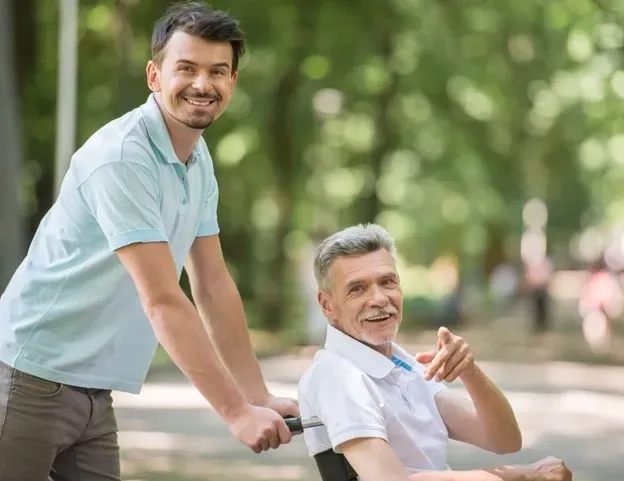
My wife, Carlin, and I have six grown children, seventeen grandchildren, and six great grandchildren. Our world was turned upside down three-and-a-half years ago when Carlin slipped on a wet sidewalk during her daily walk. She called me and I came rushing to help and was able to get her to the local hospital. They did x-rays and determined that she had broken her hip and needed replacement surgery.
The surgery went well but when she came out of the anesthesia, she was unable to talk. It turned out she had suffered a mild stroke during the surgery that affected her speech. Suddenly my independent, healthy, athletic wife was going to need support and caregiving. I was terrified. My first thought was _how can I possibly take care of my wife if she is unable to talk to me._ Fortunately, her ability to speak returned slowly after several months.
In the immediate days after her surgery and stroke, as I prepared for Carlin to return home, I realized that I had experience helping loved ones that can’t talk. It’s called being a dad and nurturing young children. It all began for me on November 21,1969 as a twenty-five-year-old father coaching my wife through the Lamaze breathing techniques we had learned in our birth-preparation classes.
My wife was in the last stages of labor at Kaiser Hospital when the nurse announced,
“Mr. Diamond, you’ve done your job. You can go to the waiting room, and we’ll notify you when can see your wife and child.”
We knew the rules. Fathers were not allowed in the delivery room back then. I kissed my wife, wished her well. She was wheeled in one direction to complete the birth process, and I headed the other way to the waiting room.
As I started through the waiting-room doors, I couldn’t go through them. I heard the voice of my unborn child calling to me. _I don’t want a waiting-room father. Your place is here with us._ I turned around and made my way to the delivery room. There was no question of leaving if asked. My baby and my wife needed me, and I was there to stay.
Shortly, thereafter, our son, Jemal, was born and I made a vow that I would be a different kind of father than my father was able to be for me and to do everything I could to create a world where fathers were fully engaged with their families throughout their lives.
That commitment took on new meaning when my wife announced that she needed a break from full-time caregiving and wanted to go on a trip with a girlfriend. My hesitation lasted only a second, drowned out by my desire to please her and to prove to myself I was truly a “liberated” husband. She left the next day and two-year old Jemal and I were left to take care of each other.
The first day went fine. We wrestled and played, talked about dinner and how fun it was to have the two men together. He finally was ready to sleep after three stories and a rather unusual rendition of Brahm’s Lullaby (It always sounded so nice when my mother sang it to me). The fears and worries soon began to creep in. What will I feed him in the morning? What will I do if he starts crying and I can’t get him to stop? What if I screw up and something happens to my son? Even when I provided hands-on care with Jemal, I knew my wife was there if I needed her. Now, it was just me and my baby boy.
I believed that women had some innate wisdom that enabled them to care for young children that men just didn’t have. I felt I had been thrown into the deep end of the pool. What if I go under and take my baby with me?
One of the good things about being with a two-year old is that you don’t have a lot of time to dwell on your fears. Jemal needed me and I quickly learned what to do when he was upset. Is he hungry? Is he wet? Does he need his diaper changed? If those don’t work, I held him, walked with him, talked to him, touched and cuddled him. In the two weeks my wife was away I learned three lessons that have stayed with me my whole life:
Males can learn to be competent caregivers. Our children will teach us if given the opportunity.
Being a hands-on caregiver changes your life forever. You learn the reality, in body and soul, that love is letting go of fear.
When love infuses our lives, we gain a quiet competency that gives us the power to care for our families, ourselves, and all living beings. Caregiving changes the world for good.
The caregiving we give children can lay the foundation for adult caregiving later in life.
In recent years the importance of male caregivers is being more widely recognized. Sarah Blaffer Hrdy is professor emerita of anthropology at the University of California, Davis. She is the author of the classic book, _Mother Nature._ In her recent book, _Father Time: A Natural History of Men and Babies,_ she draws on a wealth of research and says,
“Men in prolonged intimate contact with babies exhibit responses nearly identical to those in the bodies and brains of mothers.”
In her book, _Dad Brain: The New Science of Fatherhood and How It Shapes Men’s Lives,_ clinical psychologist Dr. Darby Saxbe says,
“Over the last decade, we’ve learned more about the transformative power of parenthood — biologically, psychologically, and socially — than ever before. But while the experience of motherhood has attracted a well-deserved attention, fatherhood has remained overlooked, and often, misunderstood.”
Dr. Saxbe goes on to say,
“Becoming a father changes men, from their bodies and brain architecture to their hormones and sense of purpose. Fatherhood can help men discover a richer, more connected, and more meaningful life.”
My experience of caring for children has truly changed my life and enabled me to be a good caregiver for my wife Carlin. As the population ages, caregivers are needed now more than ever. Data from AARP and the National Alliance for Caregiving (NAC) indicates that men make up roughly 38% to 40% of the family caregivers in the United States, representing over 20 million men. This reflects a steady climb from earlier decades, driven by shifting family dynamics, an aging population, and a lack of alternative care options.
Organizations like AARP note that men are often less likely to join community support groups or verbally express burnout. This isolation makes them highly vulnerable to stress and depression.
Ed Frauenheim is a writer, speaker and consultant who has focused on masculinity, culture and workplace matters for more than 25 years. Ed spent several years as a caregiver for his aging father. Ed lives in San Francisco. He is the father of two adult children and husband of the artist and educator Rowena Richie.
According to Frauenheim,
“Older adults, caregivers, and many men often experience a gradual loss of connection long before they reach a crisis. Retirement, caregiving responsibilities, the loss of a spouse, changes in health, or shifting family roles can quietly lead to social isolation, reduced purpose, and declining well-being. Too often, people seek support only after these challenges have become overwhelming.”
## Support for Male Caregivers
Starting in 2027, Ed Frauenheim and I will be offering the following services in support of male caregivers:
Consultation, teaching, and training for organizations in California and throughout the U.S. to improve their services for male caregivers.
Coaching, support, and clinical services for men taking care of spouses and/or aging parents.
Coaching, support, and clinical services for men working professionally as caregivers including doctors, nurses, nurse practitioners, health aids, and other care workers.
Coaching, support, and clinical services for fathers trying to balance work, life, family care, and their own health and wellbeing.
If you are interested in learning more about these services, please send an email to me: [email protected] and put “Male Caregivers” in the subject line.

Best Wishes,
Founder and VHS (Visionary Healer Scholar) of MenAlive
Publisher: Source link