
Image above: Milwaukee VA Medical Center, Public domain, via Wikimedia Commons.
APS’s Advocacy Task Force is committed to bringing psychological science into the forefront of both public policy and public understanding. This regular column features insights from psychological scientists and other advocates who champion strong and fair science-driven policy.
Explore the APS Advocacy & Policyhub, your gateway to up-to-date policy statements, expert analysis, action tools, and resources to engage meaningfully with legislation, funding decisions, and public discourse.
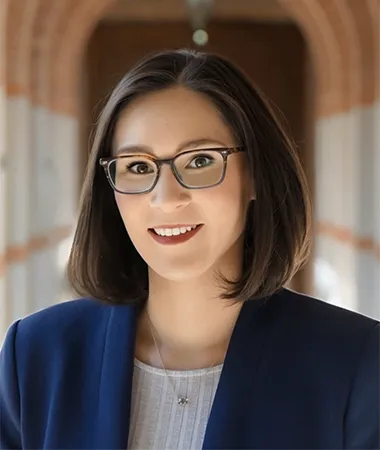
Allie Sinclair’s research straddles the invisible line between basic and applied science, and she wishes more psychological scientists would follow suit. She recently joined Rice University as an assistant professor, where she directs the Learning and Behavior Change Lab. She is a cognitive neuroscientist who studies how people update their memories, beliefs, and behaviors in lab and real-world settings, using techniques ranging from brain imaging to large-scale online field studies. Her expertise spans learning and memory, belief and behavior change, affect, and information consumption.
During the COVID-19 pandemic, Sinclair studied how people perceive and respond to health risks. She and her colleagues found that older adults more readily perceived the risk of COVID-19 transmission after imagining a personalized scenario with social consequences. She also studied why some adults skipped a booster shot, finding that many were unaware they were eligible, didn’t know where to get it, or believed they were already immune. With her collaborators, Sinclair helped develop the COVID-19 Event Risk website, built to communicate exposure risk in local communities, and the COVID-19 Immunity Estimator, which gives personalized estimates of how protection against COVID-19 wanes over time.
Sinclair is also a colead of the Science & Community Impacts Mapping Project (SCIMaP), an effort devoted to documenting how funding cuts affect communities across the United States. In this interview with the Observer’s Managing Editor Hannah O. Brown, Sinclair discusses the challenges and opportunities of launching a lab in the current political climate and emphasizes the importance of building a network of interdisciplinary collaborators.
Brown and Sinclair spoke on September 23, 2026. Edited excerpts of their conversation follow.
Much of your work has focused on translating cognitive neuroscience into interventions for climate and health communication. What inspired you to pursue this kind of applied research?
I actually started off being very much a basic scientist. I was someone who was interested in learning and memory, especially how people learn from error. Like when we make a prediction and it’s wrong, or we get feedback that challenges our prior knowledge, how do we update our memories as a result? That naturally led me to think about why we sometimes fail to update, whether we do or do not learn from error when something challenges our beliefs. That whole learning and updating process is directly related to adaptive behavior. The reason why we learn from experience is so that we can make better choices in the future based on what we’ve learned.
I was still thinking about that from a pretty basic-science angle until the COVID pandemic hit. I was about halfway through grad school, and I felt sort of an existential reflection on the state of science and society and thinking about this kind of reductionist research that I was doing versus what I was seeing in the world around me. I started thinking critically about how we could take insights from psychology and neuroscience and try to apply that to address these societal challenges.
Especially in that context, we saw the burden of responsibility shift onto individuals. It started off that the government, either local or federal, was mandating what you could or could not do. Then the lockdowns lifted, and it was up to individual risk tolerance, and people were needing to figure it out on their own. So I pivoted to think about how I could take the same fundamental cognitive processes that I was studying and apply them to develop interventions for health communication.
That started as a spin-off project that felt really fulfilling in that moment and ended up growing and growing until it became a fundamental part of my research program. [I was] thinking about that translational aspect, not to the clinical domain, but to real-world contexts and how we can leverage mechanisms of cognition in order to help people make better choices, learn from feedback, and update their beliefs and behaviors. When I looked for postdoc opportunities, I very intentionally wanted to find someone who was doing that sort of bridge work as well. I still identified as a neuroscientist, so I wanted somebody who also thought about the brain and went all the way from neural mechanisms up to real-world interventions.
That brought me to Emily Falk. She had done prior work on health communication and interventions for behavior change. I reached out to her, drawing on what I had done recently in the health domain. She said, “That’s all great, but I actually want to start a new line of work on climate-change behavior. Would you be interested in leading it?” Even though it was a different application domain, I realized we can use a lot of the same strategies, and the same psychological and neural mechanisms can be applied to health and climate domains.
It’s so interesting that you’re going all the way from neural processes to intervention. Is it difficult to find people doing that kind of work? It seems so expansive.
Absolutely. Very few people are doing it, and I wish that more people would. I hope that can be an inspiration or a call to action for other researchers. You don’t have to choose between societal impact and understanding the brain if you’re someone who really cares about the brain. I think studying the brain can give us new insight into what message features we might tweak, what outcomes we should measure, or what’s effective and why.
Sometimes behaviorally, we might see a similar expression of something, and then in the brain, we realize there are actually different systems that are producing those similar looking effects. That might give us new insight into different mechanisms we could pull on to try to encourage people to learn better or make certain choices.
Could you give an example of that? That’s fascinating that one behavior could look the same but have two different cognitive reasons.
There’s some recent work that I did in my postdoc where we looked at how the emotional or motivational framing of news headlines about climate and health-related topics influences what people want to read and share with other people and what they end up remembering later on. What we find is that if you take the same news story and reframe it to emphasize crisis versus opportunity, both of those strategies can lead to increases in engagement in the moment. Crisis framing has slightly stronger effects overall.
But the next day, these framing strategies actually lead to opposing effects on memory. Opportunity framing enhances detailed memory for the news content, whereas crisis framing doesn’t hurt memory for the focal details, but it impairs memory for associated information, like the image that was paired with the headline. We think that could be important for other factors, like maybe source memory or preventing corruption of that memory trace when you get exposed to misinformation in the future and so on.
We predicted these different effects, and chose to measure delayed memory outcomes, because of predictions from a theory of how neuromodulatory systems drive motivational states in the brain, shaping immediate choices and future memory. Without this foundation in neuroscience, we may not have discovered that—despite similar effects on immediate engagement—these framing strategies have very different effects on memory.
That seems like a very actionable piece of information. In that same vein, could you talk about findings from your research that you think have had the biggest societal impact? What do you think caused those findings in particular to be so influential?
So far, the COVID work. We first, in some survey work very early in the pandemic, discovered a misalignment whereby people’s beliefs about risk—like how risky they thought it was to do various activities in everyday life in their communities—strongly predicted their actual behavior and their future intentions to take risks, and yet were totally unmoored from reality. There was no correspondence between their personal beliefs about risk and actual objective exposure risk in terms of the number of COVID cases that were circulating in their local area at the time that they did the survey. We’d gone into this thinking that there would be some sort of alignment there, and there really wasn’t any.
So, we thought, let’s develop an intervention that could realign those beliefs about risk. We came up with an intervention that combined two different mechanisms, drawing inspiration from the neuroscience literature: an imagination exercise, which engages the hippocampus to help people form stronger memories and encourage future-oriented decisions; and a quiz that used feedback learning to try to update beliefs about risk by having people generate guesses about risk levels for different events in their community. We gave them tailored feedback based on the actual COVID risk levels in their local area on the day they did the study.
What we found was that the combination—the imagination exercise plus the quiz feedback—was effective at recalibrating those beliefs about risk to realign them with reality and discourage people from engaging in really risky activities in daily life. We did that first in a small lab sample, but then we scaled it up to have broader impact. We ended up partnering with a wonderful interdisciplinary team (led by Dr. Joshua Weitz at the University of Maryland), including people from bioinformatics, geographic information science, and other fields. They had been working on a website where they calculated exposure risk at the community level and plotted it on an interactive map of the United States. We took insights from our lab intervention to make the website more psychologically effective.
Over the course of a few years, more than 16 million people visited that website to learn about COVID risk. We collected data from tens of thousands of users [to evaluate impact], and the data aligned with our experimental findings from the original lab studies. These interactive, personalized interventions can change perceived risk and decrease intentions to do risky things in everyday life.
Can you tell me about the SCIMaP project?
SCIMaP, the Science and Community Impacts Mapping Project, blends behavioral science research with policy-relevant communication and impact. Our goal is to reveal the impact of science funding and recent science funding cuts on local economies nationwide. We want to communicate the value of science for society in a concrete way that allows people to explore and see self-relevant local impacts in their communities. We pair these impact maps with information about how people can take action in support of science funding, as well as stories and insights that dive into regional areas.
This work actually came out of the COVID work that I mentioned before. My key collaborator on that COVID website, Joshua Weitz, and I are cofounders of SCIMaP. Back in March of last year, when everything started going downhill, Joshua reached out to me and said, “What if we did something like that [the interactive COVID map] again, but for this moment in time, to address the science funding cuts and help people understand how this will actually have repercussions for their local area?”
Our team includes several people who were involved in those original COVID studies, as well as new people who have been brought on board, especially on the behavioral science side—a large interdisciplinary team of people working together to develop this work. It’s been really rewarding and fulfilling to take action on this current challenge.
I want to talk about launching a lab at this moment where federal science funding and public trust are both facing significant challenges. How has that context shaped how you have framed the priorities of your lab to your students?
It’s absolutely shaped my job search process and my thinking about the future of science and the future of my lab. I was primarily on the job market in the 2024 to 2025 cycle. And in fall 2024, when I was applying, Biden was in office and the job market seemed like it had finally recovered from COVID. There was a lot of optimism. I felt really hopeful. I knew I had another year of postdoc funding as well. So I was applying, but I wasn’t desperate. And I felt very positive about that and full of hope for my new lab.
Then 2025 happened. And in February 2025, when I was interviewing, there was a massive immediate disruption. We saw grant terminations. There was the proposal announced to drastically reduce indirect costs, which had critical implications for university budgets. Mass panic ensued. As I was interviewing at a variety of schools, I could see people getting emails from the dean about the funding cuts. I could see people having tearful, worried conversations in the hallway. Many searches that I was a part of ended up being canceled or frozen because they were no longer able to extend an offer. There was great concern about budgets. It was a really, really frightening time to be an early career researcher on the market. I felt like I was just on the verge of making it, but then everything was kind of crumbling.
Thankfully, it worked out. I accepted a great offer from Rice. I’m really excited to be here at Rice University now. I feel more protected being at a private institution, and Rice has been very supportive of the work that I do, both basic and applied.
I’ve also arrived at a time when they just launched a new Brain Institute last year. And that Brain Institute is supposed to highlight and support this kind of bridging that I do, going all the way from neurons to society and policy change. That’s really exciting for me, thinking about the power of the human mind and brain as capital, a resource that is valuable for society and worth investing in.
What lessons can be imparted to the next generation from the experiences that you’re having in this current political climate?
Yeah, I think that’s a great question. I would like to be transparent. I want people to have eyes open and understand the context that we’re in, while also feeling hopeful and like there are things that we can do to take action to support science funding and to demonstrate the value of our work for society to try to ensure the long-term sustainability of the kind of work that we do.
I also don’t want to panic my students too much. They just started. They are going to be graduating in a context that could look very different from what we have right now. And for the moment, they’re funded, they’re supported. We have the flexibility to do the kind of work that they want to do. I want to emphasize that hope and support, while also giving them a dose of grounding reality of what’s happening out there. How can we take action in support of science right now, and also keep the spark alive? They’re going to be graduating years from now, and hopefully things will look different at that point.
Can you talk about what gives you optimism about the role of psychological science, especially in addressing misinformation and polarization? And, if you’re not optimistic, what areas still have room for growth?
At the level of our field more broadly, I feel hopeful that there’s been renewed interest and support for doing this kind of use-inspired basic research, thinking critically about how we can learn something fundamental and generalizable about human psychology while also
having real-world impact. I think those things have for too long been conceptualized as a dichotomy: Either you do applied research or you care about basic mechanisms. To me, they don’t have to be in opposition. We can learn something fundamental and then we can apply those insights and that can all go hand in hand. And I think that’s really rewarding.
It seems like part of the separation between basic and applied research is this discussion of there being different skill sets. Is it an expanded skill set that you need to be able to bridge those things?
That’s a great question. I do think it’s an expanded skill set, but highly overlapping. I don’t think they’re totally different skill sets that would make it difficult for people to do both basic and applied work. But I’ll talk about the perspective of coming from the basic world and then moving more applied since that’s what I did. I think one thing that really helped was gaining experience with interdisciplinary collaborators and communicating to audiences beyond the ivory tower. Those are skills that I was not taught explicitly, and often you can go quite far in basic research without ever really needing to develop those skills.
The other part is beyond academia. If you do this kind of applied work, you want to make sure that it ends up in the hands of people who can do something with it. If you are still a scientist, that is your full-time job. You cannot run an advocacy organization or write the news stories yourself, but you can hand off your work to people who can. I’ve connected with journalists, such as through the Solutions Journalism Network, to talk about my work and offer concrete recommendations. We’ve also connected with policy-relevant groups and nonprofit organizations, especially in the environmental space.
Engaging with each of those different audiences requires learning different ways of thinking about and talking about your science. I think anybody can benefit from that, even if they’re fully focused on basic research. But especially when you’re doing more applied work, I think it’s really valuable to learn to communicate across disciplines and hand off your insights to those who can use them effectively.
Interested in learning more about the SCIMaP project? Join Allie Sinclair and members of the SCIMaP team for our webinar on November 10. Register here.
Feedback on this article? Email [email protected] or login to comment.