

We are thrilled to be previewing the Human Experience Specialist Certification Course that launches in October. Join the inaugural cohort and become one of the world’s first Human Experience Specialists. Curious what this means? Come take a look!
 There are many kinds of helpers in the world, and thank goodness for that. There are therapists, counselors, coaches, social workers, mentors, consultants, clergy, physicians, teachers, and wise friends. Each may have something important to offer. But there is also a large territory of human experience that does not fit neatly into any of these helping categories.
Imagine someone who says, “I have a perfectly good life, but I don’t know why I’m living it.” Or someone who has spent thirty years pursuing a career and suddenly realizes that she no longer wants the life that career has created. Or a man who has retired and discovers that, without his professional identity, he has very little idea who he is. Or a creative person who hasn’t created in five years and can’t decide whether he is blocked, frightened, finished, or simply waiting for something to change.
Are these people ill? Not necessarily. Do they need treatment? Maybe not. Do they have goals? Perhaps, but goal-setting may not touch what is really troubling them. Do they need advice? Almost certainly not the sort of advice that begins, “Here’s what I think you should do.”
They are having human experiences.
That may sound like an obvious statement, but it has significant implications. We have become very good at dividing human difficulties into categories. A person has an emotional problem, a relationship problem, a career problem, a motivational problem, a spiritual problem, a mental health problem. Once we name the category, we can send the person to the appropriate specialist.
But human beings do not experience themselves categorically. A woman considering leaving her marriage may simultaneously be confronting loneliness, guilt, financial fear, sexual longing, questions about identity, anxiety about aging, concern for her children, and the suspicion that she has somehow lived the wrong life. Which of those is “the problem”?
Maybe the better question is: What is she experiencing?
That question opens a different kind of helping conversation. Instead of immediately deciding what sort of problem is present and what intervention ought to follow, we become curious about the whole person standing before us. What is happening in her life? What is happening inside her? What does she believe about herself? What does she fear? What does she want? What does she refuse to want? What meaning has she been making of her situation? What possibilities can she imagine, and which possibilities has she forbidden herself even to consider?
These are not diagnostic questions. They are human questions.
Over many years of working with people, I’ve become increasingly interested in the possibility that we need a new kind of helper: someone whose area of concern is not a disorder, a particular problem, or even a particular outcome, but human experience itself.
I am calling this person a Human Experience Specialist.
The name is deliberately broad because the territory is broad. An HES might talk with someone about meaning one day, creativity the next, a difficult relationship the next, and an unwanted life transition after that. The common denominator isn’t the presenting problem. The common denominator is the human being.
This does not mean that an HES replaces a therapist, physician, coach, or any other professional. Quite the opposite. Part of wisdom is knowing what sort of help a situation requires and recognizing the limits of one’s own role. But there remains an enormous amount of living that falls outside treatment, outside diagnosis, and outside goal-setting. There are decisions to make, losses to absorb, identities to reconsider, meanings to create, realities to face, and lives to navigate.
Who helps with all of that?
Over the next several weeks, I want to explore that question and introduce the emerging idea and practice of the Human Experience Specialist. We’ll look at what it means to help the whole person, whether wisdom can become a genuine helping skill, what actually happens in a Human Experience conversation, and how accompaniment and quality questions can change the way we help.
Because sometimes what a person requires isn’t treatment, fixing, or advice, it’s another human being who knows how to meet them exactly where they are.
–
Don’t miss your chance to be a part of the first ever cohort of Human Experience Specialists. There is a HUGE early bird savings available for early registrants. Make sure to take a look!
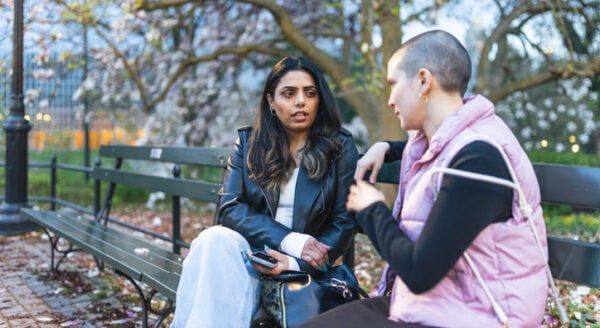
iStock image
The post What If People Need a Different Kind of Help? appeared first on The Good Men Project.
Disclaimer: This story is auto-aggregated by a computer program and has not been created or edited by healthlydays.
Publisher: Source link