

Midlife exhaustion hits heavy. Unlike youth, where sleep fixes everything, a miracle cure every night. Midlife exhaustion comes not just from disrupted sleep, long working hours, it also comes from carrying identities for too long. From maintaining structures that once fit but now feel too tight across the chest (like that cool t-shirt that has seen better days).
At some point between the responsibilities, the disappointments, the wins, the marriages, (and the divorces too), time has passed and we may pause to gaze in the mirror only to realise we have become “weathered”, like driftwood shaped by tides it never chose. Anti-aging creams and good skincare routines might help, but time makes its presence felt one way or another.
Renewable energy
Some cultures treat this weathering as something to be fixed, avoided at all costs. We turn to career reinventions, yoga retreats, even (heaven forbid) optimisation podcasts. New teeth. New spouses. New identities. Every wrinkle is marketed as a problem. Every scar is presented as something to erase. We are encouraged to become smoother, younger, shinier versions of ourselves.
As I navigate midlife, I choose to embrace my weathering, and find comfort in the Japanese philosophy of wabi-sabi. It offers an alternative perspective.
Asymmetric power
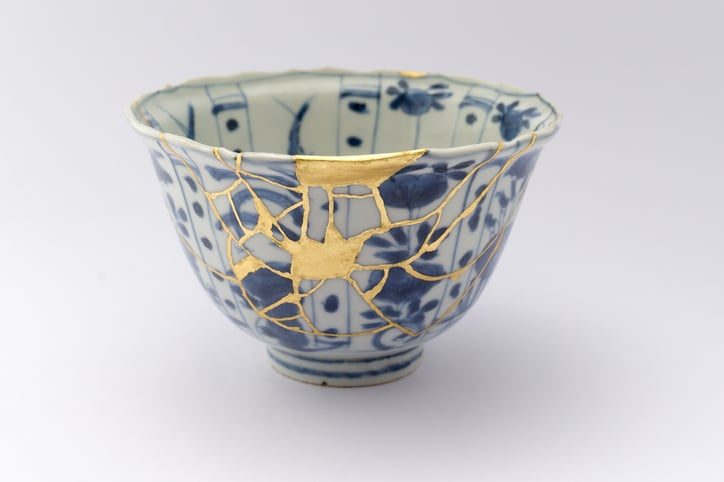
Wabi-sabi is difficult to translate directly into English because it is less a definition than a way of seeing. Broadly speaking, and as I understand it, it is an aesthetic and philosophical appreciation for imperfection, impermanence, incompleteness, and the marks left by time. It values weathered wood over polished steel. Handmade asymmetry over sterile precision. A cracked tea bowl repaired with gold rather than discarded. It says: the crack is not the end of a given object’s beauty. The crack is where the story lives on.
If there is any stage of life where this philosophy becomes essential, it is midlife, because midlife is where the cracks begin to show. The body changes first. Recovery takes longer. Sleep becomes political. A knee announces rain before the meteorologist does. I have begun making involuntary sounds when standing up.
Emotional fractures too. I recognise some ambitions as belonging to my parents, and are not my own. Some friendships that survived only through convenience. A marriage that became a business arrangement, conducted around school calendars and devoid of emotional intimacy. I am not who I imagined I would be at twenty-five. That realisation can either destroy a person or deepen them. The difference often depends on whether we believe value exists only in perfection. For my part I am OK with it. I own my mess.
Modern western culture sometimes teaches us otherwise. Useful while pristine. Valuable while productive. Attractive while smooth. Relevant while current. The moment wear appears, panic begins. We scramble to restore ourselves to an earlier edition, as though human beings should function like updated software patches.
(Bitter)sweet
Wabi-sabi rejects the fantasy of permanence. Cherry blossoms are beautiful precisely because they fall. Autumn matters because it does not stay. The old wooden temple, darkened by centuries of weather, carries a gravity no newly constructed building can imitate. Time is not vandalism. Time is revelation.
Midlife risks becoming unbearable if we interpret aging as theft instead of authorship. The irony is that the qualities people most trust in others rarely come from perfection. We trust people who have suffered and remained tender. We trust people who know disappointment but did not become cruel. We trust the man who lost everything and rebuilt carefully. We trust the woman who carries grief without needing to advertise it.
Nobody wants advice from someone untouched by life. The most compelling faces in the world are rarely the youngest. They are the faces with evidence on them.
A lined face can say: I survived. I loved. I buried people. I forgave things I said I never would.
I failed publicly. I started over privately. I witnessed. There is depth in that.
Nothing is complete
Wabi-sabi does not romanticise suffering. It does not claim pain is inherently noble (it is not). A shattered bowl is still broken. Divorce still hurts. Betrayal still scars. Regret still wakes people at three in the morning. But it instead suggests that damage need not exile us from beauty. Indeed, the damage may become inseparable from it.
This is why the Japanese art of kintsugi resonates so deeply in midlife. In kintsugi, broken pottery is repaired with lacquer mixed with gold powder. Rather than disguising the fractures, the repair highlights them. The object becomes more beautiful because it was broken and restored.
At a certain, younger age we might believe identity is constructed through achievement. Over time we might eventually learn that identity is memory. All memory. It must be embraced in its entirety, even those moment we might regret. That is where true beauty is found, in being grateful for all things.
Elysian fields
There is beauty in all things. You simply have to look for it. I went out for a run this morning through Uxbridge. It is not well known for its architectural wonders (with the possible exception of the creative, post-modern brickwork of Hillingdon Civic Centre). It’s skyline is quite ugly. Yet on this particular morning the rising sun caught the windows of each dull office tower just so, washing the empty streets in a honeyed light that lent even these steel-and-glass banalities an air of myth, as though the town had wandered by mistake into its own heroic age. So, yes, beauty in all things, even Uxbridge.
Nothing lasts
Midlife introduces us to limits. The idea of limitation appears to be profoundly unfashionable at the moment, yet limits are what shape meaning, just as mortality sharpens attention, and impermanence clarifies love. The awareness that time is finite changes the texture of ordinary moments. Coffee on the porch matters differently at fifty than it did at twenty-two. Silence becomes less threatening. I have learned to treasure every moment with my parents, no matter how trivial.
A great many midlife crises are really aesthetic crises. People look at the accumulated evidence of life and decide it should not be there. The greying hair. The softening waistline (I have handles, it’s not great). The emotional caution. We risk comparing actual existence to an impossible ideal of uninterrupted upward momentum.
Wabi-sabi invites us to stop fighting. This is not an invitation to surrender ambition or vitality, but to release the exhausting fantasy of flawlessness. A radical honesty awaits.
Nothing is perfect
No meaningful life moves in a straight line. Real lives (and real bodies) sag in the middle. Lives detour. They fracture and give pause. They contain contradictions. A man can be deeply grateful for his children and still mourn the life he never lived. A woman can love her family and still ache for forgotten versions of herself. Two truths can coexist without cancelling each other.
Just as wabi-sabi has room for paradox, so midlife must also accommodate. We can think of midlife as an entirely different season requiring different values. Discernment over accumulation. Depth over expansion. A space where tolerance for superficiality collapses.
This can feel frightening because the old identities no longer fit, yet the new ones have not fully formed. But perhaps that unfinished state is not a problem. Wabi-sabi reveres incompleteness. An unfinished room. An asymmetrical bowl. A fading garden. A weathered hand. Time in motion.
The philosophy understands something modern culture sometimes forgets: living things change shape, and midlife is shape-changing territory. It is where many men discover that strength is not hardness. It is where people begin untangling the difference between who they are and who they were trained to be. Some emerge bitter from this process. Others emerge softer, stranger, and infinitely more real. Those are usually the people who stop hiding the cracks.
There is something deeply moving about a person who no longer needs to appear invulnerable. Not theatrical vulnerability. Not curated authenticity. Actual humanity. It also invites a deepening of relationships, as we embrace and celebrate the changes we observe in our life partner and closest loved ones, and become equal to the very real privilege of being both witness and companion.
Bless the weather
That is wabi-sabi. It is presence and weathered grace.
So, perhaps the task of midlife is not to recover the person we once were, but to become someone more habitable. Someone less defended. Someone capable of sitting peacefully inside an imperfect life without needing to constantly upgrade it into worthiness.
A cracked bowl repaired with gold does not become young again. It becomes whole in a new way. Maybe we do too.
—
This post was previously published on The Wisdom Vault.
***
You may also like these posts on The Good Men Project:

If you believe in the work we are doing here at The Good Men Project, please join us as a Premium Member today.
All Premium Members get to view The Good Men Project with NO ADS.
Need more info? A complete list of benefits is here.
Photo credit: iStock
Disclaimer: This story is auto-aggregated by a computer program and has not been created or edited by healthlydays.
Publisher: Source link