


Editor’s Note:This article may be distressing for some readers. Please use caution to make your own informed decision about reading this story.
If you or someone you know is struggling, support is available. If you or someone you know is in immediate danger, please call 911 or go to your nearest emergency room. In the United States, you can call or text 988, the Suicide & Crisis Lifeline, for free, confidential support 24/7.
If you are outside the U.S., you can find local resources at findahelpline.com.
Please take care of yourself.
Some people have skeletons in their closets. Others have graveyards inside themselves.
The hardest graveyards are not always made from what other people did to us.
Sometimes they are made from what happened afterward, from the ways people carry pain when gentler forms of survival feel unavailable. That kind of haunting does not only ask, Who hurt you? It asks you : What became of the hurt after it entered the body?
There is a particular exhaustion that comes from always searching, but never finding. First, a person searches for a reason. Then comes the search for someone to blame. Then comes the search for the exact moment when the self became unfamiliar. Eventually, the search becomes less about facts and more about atmosphere.
The answer rarely arrives cleanly. It becomes humid air sitting heavy on the shoulders. It cannot be touched or pointed to directly. Still, it suffocates nearly every breath. It presses against the skin. It makes ordinary movement feel like walking through weather no one else can see.
That is one of the hauntings self-harm can leave behind. Not only the crisis itself, but the air that follows it.
Edgar Allan Poe understood that kind of air. In “The Black Cat,” the narrator is terrifying not simply because of what he does, but because of how he tells us what he has done. He explains himself without truly facing himself. He names alcohol, perverseness, irritation, madness, and fate, but he never fully sits with the horror of his own transformation. He can describe the cat. He can describe the wall. He can describe the hidden crime. Yet he cannot confront the self that made the horror possible.
That is what makes “The Black Cat” more than a Gothic confession. It is a story about the self as a haunted house.The narrator does not merely hide something behind a wall. He hides from himself. The cat is not the only thing that returns. So does the self he tried to bury.
Poe’s story belongs to a nineteenth-century world deeply preoccupied with respectability, reputation, domestic order, and hidden shame. Victorian culture often imagined morality as something visible. A respectable home, a disciplined body, a proper reputation, and a controlled public surface were supposed to suggest inward order. Gothic fiction knew better. It returned again and again to the fear that what looked respectable could still conceal violence, addiction, madness, secrecy, or spiritual decay.
That is why the wall in “The Black Cat” matters. It is not just part of the setting. It is a symbol of concealment. The narrator builds a surface over what he cannot bear to face. Yet the hidden thing does not disappear. It waits. It presses. It cries out. The wall fails because the self cannot be sealed away forever.
Before anything becomes a graveyard, something dies.
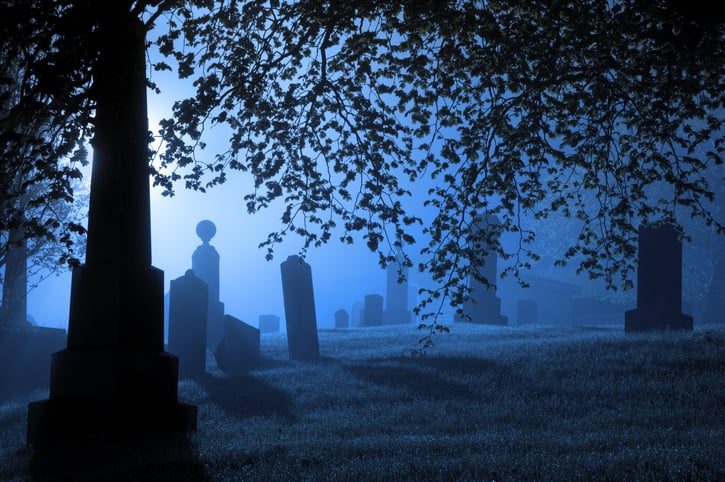
A graveyard is not the beginning of the story. It is the final geography of a loss that has already happened. Before the dirt, there is a death. Before the grave, there is a body. Before the body is lowered, it is prepared. Someone washes it. Someone dresses it. Someone places it in a box. There is a wake, a funeral, a gathering of witnesses, or sometimes no witnesses at all. Then comes the lowering, the covering, the dirt, and the silence.
Afterward, the seasons change.
Grass grows over what happened. Rain softens the ground. Flowers bloom above what no one wants to name. People walk past the grave and assume the story is finished because the surface looks still. The world keeps moving because that is what the world does. Time marches on. It does not stop long enough to ask whether something living was buried with the dead.
That is the terror Victorian culture understood so well. It was not only afraid of death. It was afraid of being mistaken for dead. The fear of premature burial was the horror of consciousness trapped beneath a surface everyone else had accepted as final. To be buried alive was to know you were still breathing while the world above you had already held the funeral.
That is what the graveyard within can feel like.
Sometimes it is not only that something in you died. Sometimes it is that something living was buried too deeply to reach. A version of yourself still breathes beneath the dirt, but the mourners have gone home. The body has been prepared. The prayers have been said. The box has been sealed. The seasons have changed above you, and still something inside keeps trying to signal upward.
You wish there were a bell.
A string tied from the coffin to the world above. A sound sharp enough to cut through the dirt. A witness close enough to hear it and say, Wait. Something is still alive down there.
The scratches on the coffin are not decorative. They are not tragic ornaments. They are proof that someone was awake beneath the earth. Perhaps the marks left on the body can be read with the same terrible tenderness. Not as beauty. Not as spectacle. Not as evidence of weakness. But as proof that something living was still trying to ring the bell from inside the dark.
That is the part that hurts. Not just the burial, but the silence after it. Not just the grave, but the fear that no one will know you were breathing the whole time. Or even visit your grave. The body becomes the coffin. Memory becomes the dirt. Shame becomes the sealed lid. Somewhere beneath all of it, something still reaches upward.
Maybe that is why the air feels so heavy. It is not only grief. It is the pressure of being buried alive inside your own history. It is the feeling of wanting someone to hear the bell before the sound disappears into the ground.
In “The Black Cat,” the hidden thing eventually cries out from behind the wall. The secret announces itself. The surface fails. The concealed horror refuses to remain silent. That cry matters because it is not simply exposure. It is interruption. It is the buried thing forcing the living to hear what they tried to seal away.
The graveyard within has its own version of that cry.
It may not sound like a shriek from behind a wall. It may sound like restlessness, memory, shame, exhaustion, or the strange feeling of always searching without finding. It may sound like the body remembering what the mind tries to make abstract. It may sound like the air growing thick around something that still wants to be named.
Self-harm, then, is not only an act. Sometimes it is part of a funeral no one else knew was happening. And no one grieves either.
This does not make self-destruction meaningful in itself. There is nothing noble about harming the self. There is nothing poetic about becoming the place where pain goes to die. Pain does not become profound simply because it leaves evidence.
But the haunting matters.
To be haunted is to know that something has not gone silent. To feel the weight of what happened afterward is not weakness. It is a sign that the self has not become entirely numb to its own existence. A person who can grieve what happened after pain entered the body is still conscious of the wound. The self is still speaking, even if the sound is muffled by dirt.
That is the distinction. Not the harm, but the horror that rises when memory returns. Not self-destruction, but the part of the self that can look backward and say, I wish I had been handled more gently. I wish I had handled myself more gently too.
The graveyard is not beautiful because it contains death.
It’s beautiful because the living can still stand inside it and read the names of what was lost.And sometimes, it matters because something buried still has the strength to ask to be found.
That is why Poe still belongs here. His Gothic world gives shape to what respectable surfaces try to deny. The wall cannot keep the secret. The house cannot remain innocent. The buried thing refuses to stay buried. In “The Black Cat,” horror does not come only from what is hidden. It comes from the fact that the hidden thing had been speaking long before anyone else heard it.
The same is true of the self.
It calls before it opens.
It presses before it explains.
It becomes atmosphere before it becomes language.
Maybe that is why the search feels endless. People search for the origin, the theology, the memory, the diagnosis, the person, and the exact moment when things shifted. Searching feels active. It gives the mind something to do with pain. It creates the illusion that if the right bone can be found, the whole burial will finally make sense.
Sometimes, the answer is not a single object waiting to be found. Sometimes what people are looking for is the version of themselves they left behind.
The one who was overwhelmed.
The one who was afraid.
The one who did not know how to survive gently.
The one who still lives somewhere inside the weather.
To sit with what is buried is not to glorify it. It is to stop pretending it is not there. It is to admit that the air is heavy because something still wants to be witnessed.Maybe the beginning is not forgiveness. Maybe it is not closure, peace, or healing in any clean sense. Maybe the beginning is simply consciousness.
There is something powerful in that. Not because pain is good. Not because self-destruction is sacred. But because feeling means the self has not gone silent. Awareness means the graveyard has not become the whole world. The very act of recognizing the weight is proof that something inside the self is still reaching toward life.
The graveyard is not beautiful because it contains death.
It matters because the living can still stand inside it and read the names on each tombstone of what was lost. To the person sitting in the weight of what they once did to themselves, the haunting is not proof that you are beyond repair. It may be proof that something buried is still trying to breathe.
—
This post was previously published on ILLUMINATION.
***
You Might Also Like These From The Good Men Project

If you believe in the work we are doing here at The Good Men Project, please join us as a Premium Member today.
All Premium Members get to view The Good Men Project with NO ADS.
Need more info? A complete list of benefits is here.
Photo credit: iStock
Disclaimer: This story is auto-aggregated by a computer program and has not been created or edited by healthlydays.
Publisher: Source link