
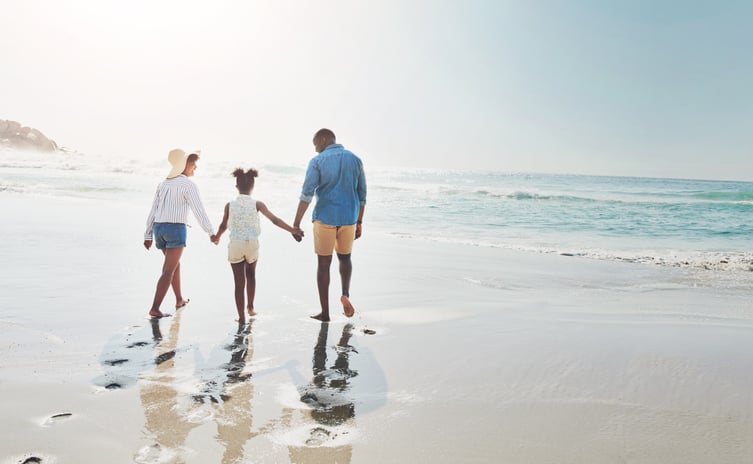

Twenty years ago, as a young graduate student in Howard University’s film program, I spent a summer traveling across the U.S. interviewing Black fathers about their experiences. My goal was to shed light and shift the narrative around Black fatherhood — beyond the deadbeat dad stereotype, toward a nuanced and accurate representation. Each father shared their personal challenges of fatherhood — such as figuring it out without a role model, co-parenting after ending a relationship, and making ends meet while still being present.
I also asked them about the joys of fatherhood and watched them light up as they shared their enjoyment in playing with their kids, cooking for them, coaching them in sports, and passing down knowledge of their heritage. I eventually curated these interviews into my first feature-length film, The Black Fatherhood Project.
This month marked my second Father’s Day as a dad myself, and I still often think about the observations and assertions those men shared with me that summer. In the time since, I’ve continued doing social justice work around gender-based violence, collaborating with advocates and people who have caused harm in their relationships to help end the cycle of violence.
I’ve discovered the connections between the abuse that happens at the interpersonal level, social structures that allow these norms to thrive, and trauma that cycles through generations. Now, as a father to a sweet little girl, I have found my perspective pushed even further. I’m curious about what wasn’t said during those interviews, or rather, the questions that I didn’t ask.
Like most parents, my wife and I want our daughter to be kind, happy and safe — but what does safety really mean? What kind of safety can we ensure in a society deeply rooted in sexism and patriarchal violence? How do we teach her to be safe — without instilling a fear of men or of people who’ve committed past harms? How do we show her to be strong without masking her vulnerability? To be assertive yet expansive in her compassion?
Our daughter is just a toddler, but these questions already feel urgent. The likelihood of a woman experiencing domestic violence or sexual violence in the United States is extremely high. According to a study released this year from the Centers for Disease Control, about 1 in 5 women have experienced sexual violence, nearly a quarter have experienced physical violence, and about 1 in 8 have been stalked.
Given this prevalence, I’m convinced that my daily thoughts and actions as a parent matter and help to keep her safe. If she does experience harm, I hope we give her the confidence to respond in a way that doesn’t betray her own values. I work daily to model safety, respect, and accountability so my daughter can recognize what healthy behavior looks like in others. Currently, my daughter’s favorite word is “no,” and she has at least a thousand unique ways to say it to fit any mood. And, as most toddlers are, she is experimenting with how far she can throw her utensils and food — or whatever’s in her reach, across the dining room into the kitchen. Resisting the urge to punish with anger and disdain is not easy.
My wife and I work each day to balance honoring her voice, choice and movement — really, a toddler version of autonomy — while teaching positive habits and respect for others. This means recognizing the idea or emotion she’s attempting to convey while correcting her behavior and teaching another way. We don’t always get it right, but our work to improve is constant.
But me only doing my part as a parent and husband isn’t nearly enough to end violence against women and marginalized groups. I believe my responsibility as a parent — all of our responsibility as parents — is not only to work to change conditions within our family unit, but also in the community.
This includes seriously addressing what is happening with men and boys, the evidence of which is overwhelming. Nearly all mass shooters are men. And though men only make up about half of the population, nearly 80 percent of U.S. deaths from suicide are men. Young men with lower educational attainment who face poverty also report the least social optimism and connection, helping explain their sometimes closer alignment to rigid masculinity and toxic values.
Yet women and marginalized groups bear the brunt of this problem. So, our call to action is clear: We need to heal the psychological ruptures caused by destructive ideals of masculinity. It will require us to tend to the wounds of trauma through self-work and collective care, in order to model what personal and communal transformation looks like.
As parents, it means creating space for these conversations, holding one another to a higher account, and taking social action that removes manhood as an aspiration one must dominate and exclude others to ascribe to. Abolishing patriarchy isn’t just about freeing women, transgender, nonbinary and gender-expansive individuals from an oppressive system. It’s also about freeing men and boys from the heavy constraints imposed on their emotions and identity. It’s work that must be done together, and, with it, we can save lives and create a world that’s safer for our kids to live in too.
Jordan Thierry is a partner at the Alliance for Boys and Men of Color and the author of “A Kids Book About Systemic Racism.”
This article first appeared on California Health Report and is republished here under a Creative Commons Attribution-NoDerivatives 4.0 International License.
—
Previously Published on calhealthreport.org with Creative Commons License
***
–
The world is changing fast. We help you keep up.
We’ll send you 1 post, 3x per week.
Join The Good Men Project as a Premium Member today.
All Premium Members get to view The Good Men Project with NO ADS. A complete list of benefits is here.
—
Photo credit: iStock
Disclaimer: This story is auto-aggregated by a computer program and has not been created or edited by healthlydays.
Publisher: Source link