

By Will Atwater
When it comes to the American landscape, litter is nearly as ubiquitous as trees and waterways.
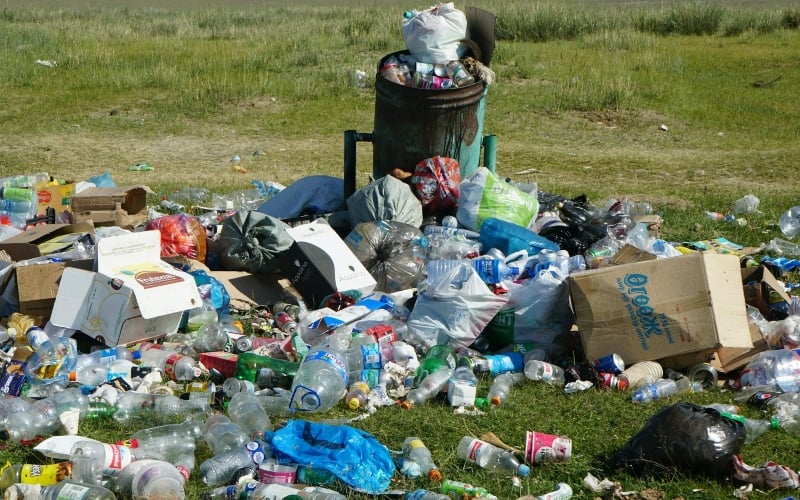
Now new research indicates it’s expensive too. A recent Duke University study estimates that litter costs society between $400 million and $1 trillion every year, once public health, environmental and economic damages are factored in.
Unlike traditional litter studies that focus mainly on cleanup costs, the Duke research seeks to measure the downstream consequences of plastic throughout society: microplastics entering drinking-water supplies, harm to wildlife and fisheries, clogged stormwater systems, degraded soils and coastlines, and lost economic productivity. When these factors are added up, the researchers estimate, plastic litter becomes not just an environmental nuisance but a multibillion-dollar drag on public health and local economies.
Nancy Lauer, a staff scientist at Duke’s Environmental Law and Policy Clinic, said the team wanted to “put forward the known costs associated with the plastic life cycle” because cost information plays an important role in shaping public policy. She added that the study highlights what researchers already know about the harms and costs of plastics — and where clear harms exist without any previous cost data.
To reach their estimate, the researchers reviewed hundreds of studies documenting the effects of plastic pollution on human health, ecosystems, infrastructure and local economies. They assigned dollar values to a wide range of impacts — including stormwater infrastructure damage, fishery losses, degraded coastlines and exposure to microplastics — and calculated low- and high-end scenarios to reflect gaps in national data.
The authors say the final range is likely conservative because many documented harms still have no cost estimates at all.
The single biggest contributor to the study’s estimate was the growing body of evidence on plastics’ effects on human health — a field that is expanding dramatically, Lauer said.
“One thing that’s changed a lot in the last five years is how far the health literature has come,” she said. “Had we written this report three, four or five years ago, most of the studies that we relied upon for the health data would not have existed.”
The heavy toll of plastic litter
The report estimates the health effects of plastic pollution to be the lion’s share of the overall total, as much as $900 billion annually.
The Cost of Litter in North Carolina study, released earlier this year, found that in 2023, litter removal alone cost North Carolina taxpayers more than $56 million. Researchers combed through data from the North Carolina Department of Transportation, local governments and nonprofit organizations to arrive at that figure.
But as the Duke study notes, a mounting body of research shows that plastic pollution is not just an environmental issue, but also a growing public-health concern. A 2023 Duke University study found a potential link between nanoplastics and a brain protein associated with Parkinson’s disease and some forms of dementia. Other studies suggest links between ingested microplastics and inflammatory bowel disease. Hormone disruption is another posited effect of digesting tiny particles of plastics.
For instance, people take an average of 16 breaths a minute, more than 8.4 million breaths each year: One 2019 report suggests people inhale between 74,000 and 121,000 microplastic particles during that timeframe.
Science on this topic is evolving.
Recent studies have detected microplastics in human blood, lung tissue and placental tissue, raising questions about how long these particles remain in the body and what long-term health effects may follow. Researchers say many of these harms are difficult to quantify, which means current cost estimates could very well understate the true health burden.
Mitigation/prevention efforts
N.C. State University graduate student Madison Haley, a co-author of the North Carolina litter-cost report, is also part of a National Oceanic and Atmospheric Administration–funded project examining how trash moves through urban waterways such as Raleigh’s Marsh Creek. As part of that work, researchers are conducting roadside litter inventories across the city and will develop recommendations for officials on how to reduce litter accumulation in urban areas. Plastic debris that washes into creeks can break down into microplastics, threatening aquatic ecosystems and entering the food chain when consumed by fish and shellfish — a cycle Haley and other researchers are working to interrupt.
To better understand how debris travels through the watershed, the team has released GPS-equipped plastic bottles into Marsh Creek to track how quickly litter moves downstream and how far it can travel. Some bottles have traveled miles within days, offering a real-time picture of how easily urban trash can reach the Neuse River and, eventually, the coast.
Haley said she and her colleagues are testing a range of strategies to curb plastic litter, from adding more trash cans and signs, to installing trash traps and stormwater control measures that keep debris out of waterways. Some of these interventions show promise, she said, but they can be expensive and difficult to maintain.
“It’s like, oh, you want to clean up the problem after it happens, or do you want to prevent it?” Haley said.
In June, N.C. State University Extension Assistant Professor and North Carolina Sea Grant Extension Specialist Barbara Doll told NC Health News that the next phase of the project will focus on developing targeted interventions to reduce litter. She said her team has been studying the behaviors behind littering — who is doing it, why people choose not to use trash cans, and what motivates or discourages proper disposal — to better understand why trash ends up on the ground or tossed from cars.
“We have some trash-can deserts in areas,” Doll said. “If someone’s on foot, they’re walking to the bus station from the convenience store and there’s no trash can along that path. They don’t want to keep carrying that trash, so they dump it in the bushes or on the ground or on the sidewalk.”
She said the challenge now is determining “how can we provide more opportunity for disposing of trash correctly, and how do we motivate people to actually use trash cans to do that properly?”
Reducing waste in medical settings
Another emerging effort to curb plastic waste is the Gloves Off Campaign, an international movement gaining traction in the medical community that urges clinicians to use disposable gloves only when necessary. The initiative aims to reduce the estimated hundreds of billions of single-use plastic gloves used by medical professionals globally each year. In the U.S., clinicians use more than 100 billion plastic gloves annually, many of which end up in landfills or the environment. Researchers note that single-use medical supplies, including gloves, contribute to the U.S. health-care sector’s carbon footprint, which accounts for about 8.5 percent of the nation’s total greenhouse gas emissions.
“I finished nursing school in 1978, and I worked as a public health nurse and gave thousands of vaccinations, and have never ever worn a pair of gloves for a vaccination,” said Julie Jacobson Vann, associate professor and planetary health coordinator at the UNC Chapel Hill School of Nursing.
“If you look at the Joint Commission, the CDC, World Health Organization guidelines, in general, gloves are not needed for vaccinations unless there’s [an] open wound or some other issue. A lot of practices have been adopted and aren’t necessarily based on evidence or based on best practices.”
Duke University students asked about the study said they know it’ll be up to their generation to turn things around. Freshman Weiyee Mock said tackling plastic waste will require people to act collectively, beginning with small, everyday choices — using reusables, cutting back on plastic and making more sustainable decisions.
“Start in your own personal life and try to control what you can,” she said.
This article first appeared on North Carolina Health News and is republished here under a Creative Commons Attribution-NoDerivatives 4.0 International License.
—
North Carolina Health News is an independent, non-partisan, not-for-profit, statewide news organization dedicated to covering all things health care in North Carolina. Visit NCHN at northcarolinahealthnews.org with Creative Commons License
***
—

If you believe in the work we are doing here at The Good Men Project, please join us as a Premium Member today.
All Premium Members get to view The Good Men Project with NO ADS.
Need more info? A complete list of benefits is here.
—
Photo credit: unsplash
Disclaimer: This story is auto-aggregated by a computer program and has not been created or edited by healthlydays.
Publisher: Source link